
Short answer: force and travel limits are two separate settings on your garage door opener that control how far the door travels before stopping and how hard the motor pushes before it decides something is wrong. If someone in your house has been turning the force dial up because the door 'just needs more muscle,' that's usually the wrong move — and it's often what's actually damaging the door, not fixing it.
What Travel Limits Actually Do
Travel limits tell the opener exactly where "fully open" and "fully closed" are. The motor runs until it hits that programmed point, then stops. If the limits are set wrong, you'll see one of two problems:
- The door stops a few inches before it's fully closed, leaving a gap (bad for keeping out cold air and mice).
- The door tries to keep going after it's already closed, which jams the bottom panel into the floor or the top section into the header.
- On the way up, the door either stops short of fully open or keeps pulling after it's open, straining the top roller brackets.
Travel limits are purely about position. They don't know or care how much resistance the door is putting up — that's the other setting.
What Force Settings Actually Do
Force is how much effort the opener is allowed to use before it assumes it's hit an obstruction and reverses or stops. This is a safety feature, required for a reason: if a kid's bike, a pet, or a foot is under the door, the opener needs to back off instead of pushing through it.
When the force setting is too low, the door reverses on things that aren't real obstructions — a little extra stiffness from cold grease, a slightly bent track, a spring that's lost tension. That's annoying, but it's safe.
When the force setting is too high, the opener will push through real resistance instead of stopping. That's the dangerous direction, and it's also the one that wrecks doors over time, because the motor keeps straining against whatever the actual problem is instead of alerting you to it.
Why Cranking the Force Up Is the Wrong Fix
Here's the argument-ending part: if a door is struggling to open or close, turning up the force doesn't fix the struggle — it just makes the opener strong enough to overpower it. The door still has the underlying problem. Common underlying problems that get masked by high force settings include:
- A weakening or broken spring. Springs do the heavy lifting; the opener is only supposed to guide the door, not lift it. If a spring is losing tension, the opener compensates by working harder — and a high force setting lets it keep doing that instead of stalling, which is the warning sign you'd otherwise get.
- A bent or misaligned track. Rollers fighting a track that's slightly out of alignment create resistance that looks like "the door needs more power," when really it needs the track straightened.
- Dry or worn rollers and hinges. Friction from aging hardware shows up as resistance the opener has to push through.
Push the force setting high enough to overpower any of these, and you're asking the opener to do the spring's job, the track's job, and its own job at once. That's how you get stripped gears in the opener, bent top sections, pulled-loose brackets, and eventually a door that comes off its track entirely — usually at the worst possible moment, like a cold morning when you're already late.
Where Bountiful's Climate Makes This Worse
Big day-to-night temperature swings and genuinely cold, snowy winters mean garage door hardware here deals with more expansion and contraction than it would in a milder climate. Grease on rollers and tracks thickens in the cold, metal track brackets contract slightly, and a door that moved freely in September can feel stiffer by December. If someone responds to that seasonal stiffness by cranking up the force instead of lubricating the rollers and checking the track, the opener spends the whole winter compensating for a problem that was never about power in the first place. By spring, you may be dealing with a stripped opener gear or a damaged panel that had nothing to do with the cold and everything to do with the force setting.
How to Check Yours (Without Guessing)
- Find your opener's manual or the sticker on the motor housing — force and limit adjustment is usually two small dials or a button sequence, and it varies by brand.
- Test the door by hand with the opener disconnected. It should lift and lower smoothly with moderate effort. If it feels heavy or uneven, that's a spring or track issue, not an opener setting issue.
- With the opener reconnected, place a 2x4 flat on the ground under the door and run it closed. A properly set force should reverse on contact with the board. If it crushes through, the force is set too high.
- Check that the door fully seats on the floor when closed and fully clears the opener's travel without straining — adjust limits in small increments if not.
When to Call Bountiful Garage Door
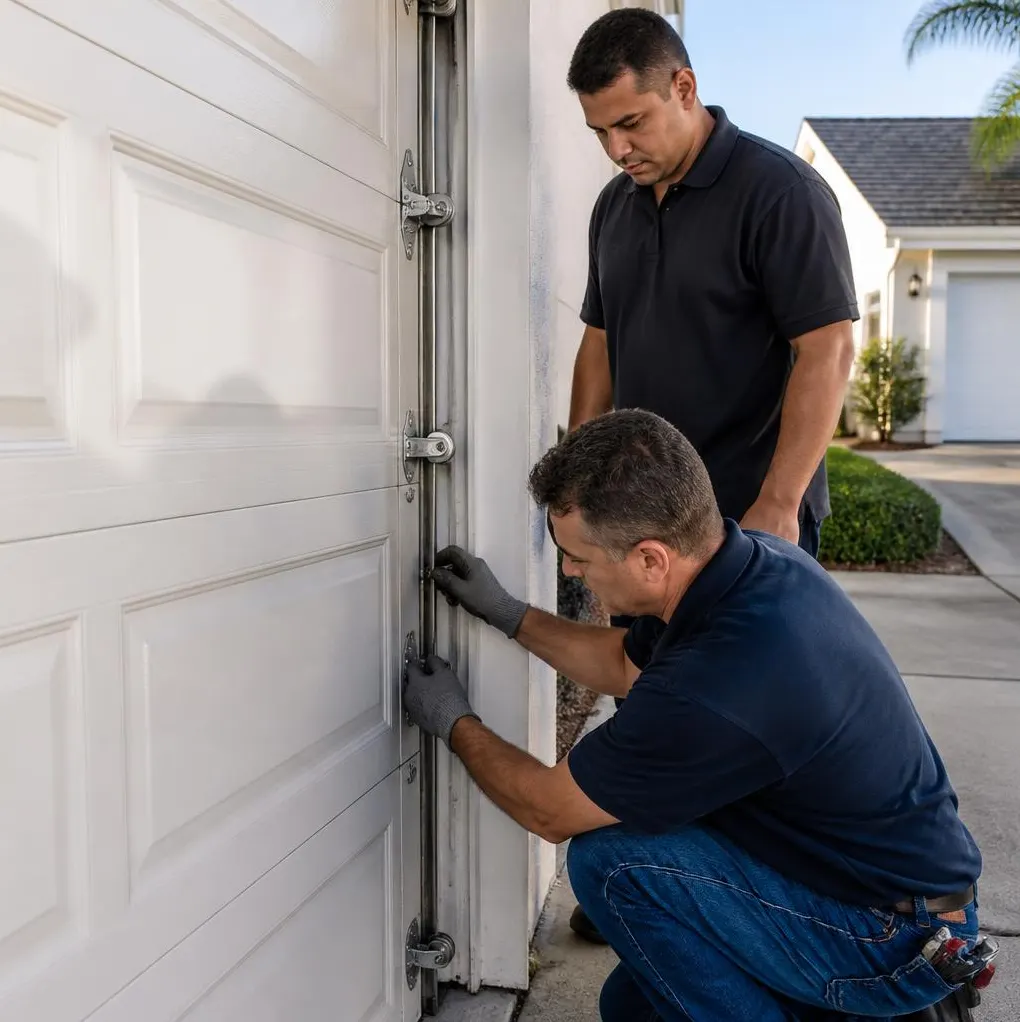
If the door only started struggling recently, if it's noticeably heavier than it used to feel when lifted by hand, or if the opener seems to be straining rather than smoothly operating, don't just keep adjusting the force dial. That's exactly the scenario where our garage door opener repair technicians check whether the opener is actually the problem or whether it's compensating for worn springs, rollers, or a misaligned track. We also handle straightforward garage door maintenance visits — lubrication, hardware checks, and correct force/limit calibration — before winter settles in and makes any existing issue more obvious.
If you're in Bountiful, North Salt Lake, Woods Cross, Centerville, West Bountiful, Farmington, Kaysville, or Layton and your opener seems to be fighting the door instead of just guiding it, give Bountiful Garage Door a call. We'll find out what's actually wrong before anyone touches that force dial again.